
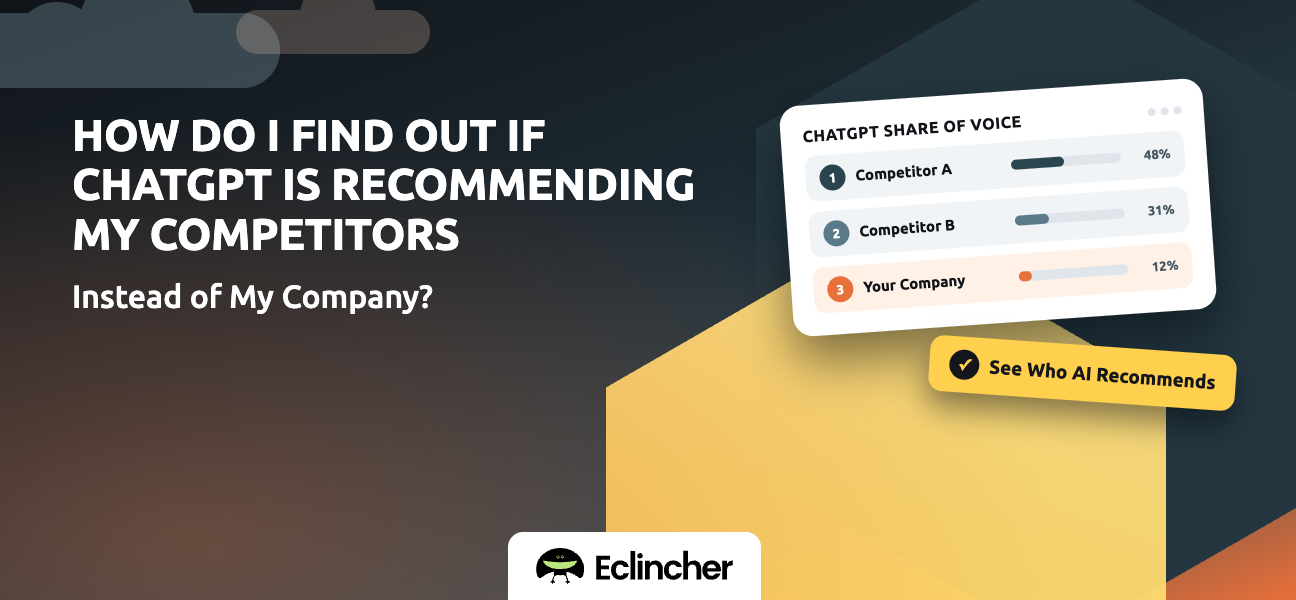




Short answer: Ask ChatGPT the same questions your buyers ask, and see who it names. Open a temporary chat, type something like “best [category] tool for small teams” or “cheaper alternative to [competitor],” and run it three times. Write down every brand it mentions and every source it links to. If competitors show up and you don’t, those sources tell you why. To keep tracking it across ChatGPT, Perplexity, Gemini, and Meta AI without doing it by hand, Eclincher AI Visibility runs your prompts automatically and flags the ones where competitors are named and you’re not.
Key takeaways
- Test the questions buyers ask. Searching your own brand name tells you almost nothing.
- Use a temporary chat, or your own history will color the answer.
- One answer is a coin flip. Run each prompt at least three times.
- The cited sources are the most useful part of the answer.
- Recheck monthly. AI answers drift as the web changes.
What happened when we checked our own brand?
We ran this exact check on Eclincher. One of our test prompts was a question our product answers directly: “How do I plan one weekly content calendar that covers Instagram, LinkedIn, TikTok, Facebook and X without duplicating the same post everywhere?”
ChatGPT named several of our competitors. It didn’t mention us once.
The sources explained it in about a minute. Competitors had pages built around that exact question: step-by-step guides, free calendar templates, even glossary entries on cross-posting. We had a feature page that said “visual content calendar” and not much else. Nothing on our site actually answered the question, so ChatGPT had no reason to bring us up.
That single check turned into a content plan, and it’s the reason this article exists.
Why does ChatGPT recommend competitors instead of you?
ChatGPT recommends the brands it can find the most evidence for. When it searches the web, it favors pages that answer the question directly, and third-party sites that name brands. In practice, competitors win for a handful of reasons:
Which prompts should you test?
Mix prompt types. Brands are often strong on one and invisible on another. We were named for some category questions and missing from almost every “how do I” question.
For more ways to find these questions, see how to find the questions your customers are asking AI.
How do you check manually?
Set aside an hour. Here’s the process we used.
- Write 10 to 20 prompts. Use the five types above, phrased the way customers actually talk. Pull wording from sales calls and support tickets if you can. Result: a test set that reflects real buyer questions.
- Open a temporary chat. Your past conversations and saved memory change the answer. A temporary chat gets you closer to what a new buyer sees. Result: a cleaner answer.
- Run each prompt three times. The same question can name different brands each time. Result: how often each brand appears, not a one-off.
- Write down the brands, in order. Note where you appear, or that you don’t. Result: a rough share of voice.
- Click the sources. When ChatGPT searches the web, it shows what it used. Result: the exact pages that name your competitors.
- Repeat in Perplexity and Gemini. Your buyers don’t all use ChatGPT. Result: a picture across engines.
A spreadsheet is enough. Yours might look like this:
To check how ChatGPT describes your own brand, not just who it recommends, see how to check what ChatGPT says about your brand.
Where does manual checking fall short?
It’s a great first look. It’s a bad long-term system.
The answers move from day to day, so three runs gives you a pattern, not a reliable number. It also adds up fast: 20 prompts, three runs, three engines is 180 answers to read every month. And without consistent records, you can’t tell whether anything you changed actually worked.
Counting how often you’re named against each competitor is called AI share of voice. Here’s how to measure AI share of voice.
How do you start winning those prompts?
Go back to the sources. They’re a map of where you’re missing.
- Get into the roundups ChatGPT cites. Email the authors with accurate, current details about your product. Most are happy to update a stale list. Result: you’re named on pages AI already trusts.
- Publish pages that answer the prompts you lost. One clear page per question beats one vague page for everything. Result: something for AI to cite.
- Say plainly what you are. The first lines of your homepage and product pages should state what you do and who it’s for. Result: AI can match you to the right questions.
- Collect reviews and show up in communities. Ask happy customers for reviews, and answer questions in places your buyers hang out. Result: independent proof.
- Run the same prompts again next month. Result: you’ll see which changes moved the needle.
How do you track this in Eclincher?
Eclincher AI Visibility does the manual process for you, across engines and over time.
- Add your prompts. Enter the category, problem, alternative, and comparison questions your buyers ask. Result: one tracked prompt set.
- Add your competitors. Up to five on the Standard plan. Result: share of voice for you and each competitor.
- See who’s named, prompt by prompt. Check which brands each engine mentions, and how often. Result: you know exactly where competitors win.
- Open the sources. See which pages each engine relied on. Result: a list of places you need to appear.
- Work your Prompt Gaps. Prompts where competitors are named and you aren’t, ranked by opportunity score. Result: a to-do list instead of guesswork.
- Watch the trend. Compare month over month. Result: proof your work is changing AI answers.
AI Visibility Standard is $249/month, billed monthly, with a 14-day free trial. It covers ChatGPT, Perplexity, Gemini, and Meta AI with 100 prompts, 4,000 responses a month, and up to five competitors. There’s also a free AI visibility audit you can run first.
FAQ
How do I see which brands ChatGPT recommends in my category?
Ask it the questions buyers ask, such as “best [category] tool for [audience],” in a temporary chat. Run each prompt a few times and record which brands appear and which sources it cites.
Why does ChatGPT mention my competitor and not me?
Usually because your competitor shows up in more of the sources ChatGPT relies on: roundups, review sites, community threads, and clear comparison pages. The cited sources show where they’re mentioned and you aren’t.
Does ChatGPT give everyone the same answer?
No. Answers vary between runs and can be shaped by a user’s history, memory, and location. A temporary chat and several runs per prompt give you a fairer picture.
How often should I check?
Monthly works for most brands. Check more often after a launch, a rebrand, or a big content push.
Can I track Perplexity and Gemini too?
Yes. Run the same prompts in each by hand, or use an AI visibility tracker. Eclincher AI Visibility Standard tracks ChatGPT, Perplexity, Gemini, and Meta AI together.
Start with ten questions this week
This week, pick ten questions your buyers ask, run each one three times in a temporary ChatGPT chat, and write down who gets named and which sources are cited. That alone will show you where you’re losing. If you’d rather not repeat it by hand every month, start a 14-day free trial of Eclincher AI Visibility and let it track those prompts across ChatGPT, Perplexity, Gemini, and Meta AI for you.

