
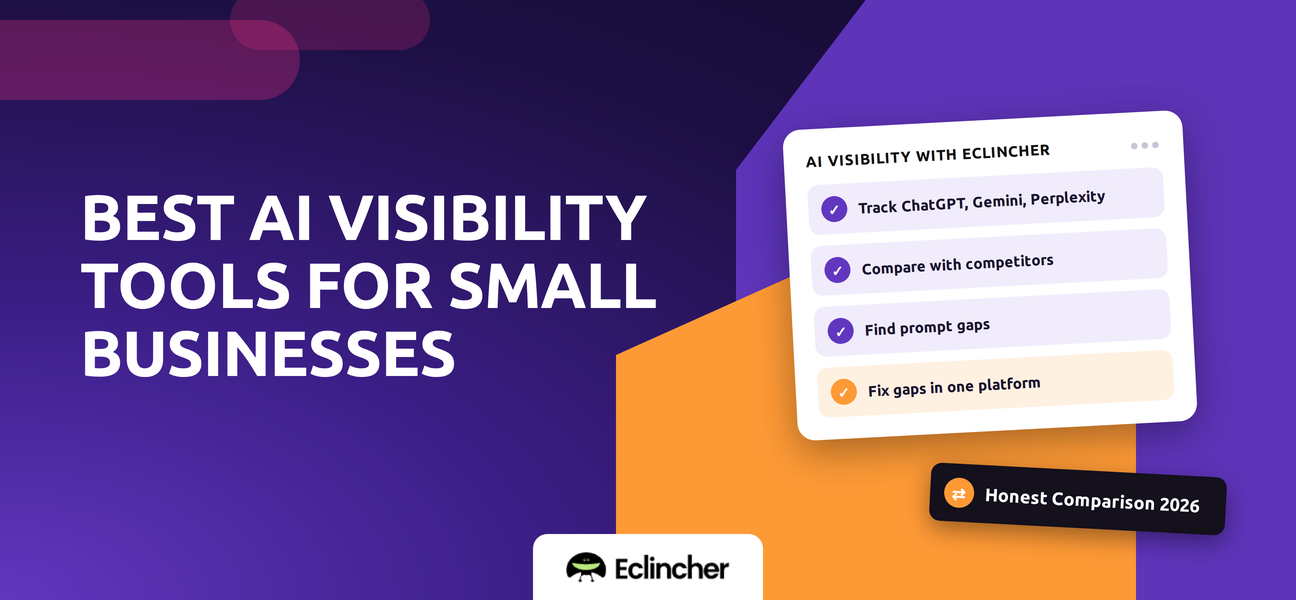


The best AI visibility tools for small businesses depend on what you need. If you only want to see where your business appears in AI answers, a low-cost tracker like Otterly.AI or AthenaHQ’s free tier is enough to start. If you want AI engines like ChatGPT, Claude, Gemini and Perplexity to recommend you more often, you need a tool that also shows you how to fix the gaps and helps you do it.
Disclosure: We build Eclincher, one of the tools in this comparison. We’ve tried to be fair, and we say where other tools are a better fit.
Key takeaways
- Most AI visibility tools analyze where you appear. Fewer help you change it.
- Each AI engine picks different sources, so showing up consistently means checking more than ChatGPT.
- On a small budget, start with a low-cost tracker to see where you stand.
- If you want to fix gaps with content, social posts and local listings in one place, choose a tool that combines tracking and action.
- You can do a basic AI visibility check for free, by hand, today.
Which AI Visibility Tools Are Best for Small Businesses?
Here is a quick overview. The last column is the biggest difference between these tools.
Prices and engine coverage checked in October 2026 against vendor pages and published reviews. This category changes fast, so always confirm on each vendor’s website.
What’s the Difference Between Tracking AI Visibility and Fixing It?
Tracking tells you where you stand. Fixing changes what AI says about you.
A tracking tool asks AI engines the questions your customers ask, then reports how often your business appears and who appears instead. That is useful, but it stops at the diagnosis. You still have to figure out what to publish, where, and how to check if it worked.
To actually get recommended more often, you need to:
- Find the questions where AI doesn’t mention you.
- Create content that answers those questions: blog posts, social posts, updated listings.
- Publish it where AI engines look, including social networks and review sites.
- Get more people talking about it, for example your own team sharing posts.
- Check again to see if AI now recommends you.
Some tools only cover step 1. When you compare tools, ask how many of these five steps each one helps with.
How Did We Choose These Tools?
We picked tools a small business with a small marketing team can realistically afford and use. We compared them on five things:
- Price: what it costs to start, and whether there is a free option.
- Ease of use: can a busy marketer set it up without technical help?
- Coverage of multiple AI engines: ChatGPT, Claude, Gemini and Perplexity each pick different sources, so a business can appear in one and be missing from another. Showing up consistently means checking several engines.
- Help to act: does the tool only report, or does it help you create content and publish it?
- Local business support: does it help with listings and local questions like “best [service] near me”?
What Does Each AI Visibility Tool Offer?
Best for Finding and Fixing Gaps in One Place: Eclincher AI Visibility
Eclincher AI Visibility is built for businesses that want to get recommended by AI, not just measure it. It shows where AI engines mention you and your competitors, then helps you close the gaps from the same platform.
- Best for: small businesses that want to fix gaps with content, social posts and local listings, or that already manage social media in Eclincher.
- Price: Standard plan from $249/month, billed monthly, with no annual commitment.
- What you get: tracking on ChatGPT, Perplexity and Gemini, 100 unique prompts and 3,000 responses a month, organized into 10 topics. The Enterprise plan tracks 11 engines: ChatGPT, Perplexity, Gemini, Google AI Overviews, Google AI Mode, Microsoft Copilot, Claude, Meta AI, Grok, DeepSeek and Kimi.
- Strengths: the Prompt Gaps view highlights questions where competitors appear and you don’t. From there, you can create a blog post with the AI Blog Writer, publish posts across social networks, have your team share them from their own profiles, and improve local listings with AI Local SEO. Then you re-check whether AI now recommends you.
- Limitations: it is not the cheapest option. The Standard plan covers three engines and doesn’t include Claude or Google AI Overviews; those are on Enterprise. If you only want to check your visibility once in a while, a lower-cost tracker is a better start.
Cheapest Paid Way to Start: Otterly.AI
Otterly.AI is the most affordable paid entry point in this list.
- Best for: small teams that want to prove AI visibility deserves a budget before committing more.
- Price: Lite from $29/month for 15 prompts; Standard $189/month for 100 prompts; Premium $489/month for 400 prompts. Unlimited seats on every plan.
- Engines: ChatGPT, Google AI Overviews, Perplexity and Microsoft Copilot on every plan. Gemini, Google AI Mode and Claude are paid add-ons.
- Strengths: low cost and easy setup.
- Limitations: 15 prompts on Lite is enough to test the idea rather than run a full program, and adding Claude or Gemini costs extra. Creating and publishing content happens in other tools.
Best for Trying It for Free: AthenaHQ
AthenaHQ offers a free tier, so you can explore AI visibility without paying.
- Best for: businesses that want to try AI visibility tracking for free, or need many engines including Claude.
- Price: free Essential tier with $25 of credit (about 300 AI responses). Starter is $295/month. Pricing is credit-based: one credit equals one AI response.
- Engines: 5 on the free tier; up to 11 on Starter, including Claude and Grok.
- Strengths: the broadest engine coverage on an entry paid plan, and unlimited seats.
- Limitations: there is a big jump from free to $295/month, and credit-based pricing takes some getting used to. It doesn’t include social media publishing, team sharing or local listings management.
Best for Dedicated Monitoring: Peec AI
Peec AI focuses on monitoring how brands appear in AI answers.
- Best for: teams that want clean analytics, flexible engine choice, and already have their own way to create and publish content.
- Price: from 95/month(80/month billed annually) for 50 prompts. Unlimited users on every plan.
- Engines: 3 engines you choose from a pool of seven; each extra engine is a paid add-on.
- Strengths: clear data and an easy self-serve setup.
- Limitations: it doesn’t help you create or publish content. Covering ChatGPT, Claude, Gemini and Perplexity together costs more than the entry price.
Best If You Already Use Semrush: Semrush AI Visibility
Semrush AI Visibility adds AI tracking to the Semrush platform.
- Best for: teams that already use Semrush for SEO.
- Price: $165.17/month (billed annually). Extra domains and users cost more.
- Engines: ChatGPT, Google AI Overviews, AI Mode, Perplexity and Gemini, with Claude added more recently. Check which engines your plan includes.
- Strengths: keeps AI visibility next to your SEO data in one login.
- Limitations: most useful if you already pay for Semrush, and costs add up across domains. Social publishing and local listings happen elsewhere.
Best If You Already Use Ahrefs: Ahrefs Brand Radar
Ahrefs Brand Radar brings AI brand visibility into the Ahrefs suite.
- Best for: teams that already use Ahrefs.
- Price: from $249/month. Covering all AI platforms costs more.
- Engines: Google AI Overviews, AI Mode, ChatGPT, Perplexity, Gemini and Microsoft Copilot. It does not track Claude.
- Strengths: part of a well-known SEO platform, with AI mentions next to your backlink data.
- Limitations: it doesn’t track Claude, and you need other tools to create and publish content.
Why Won’t Tracking Alone Get You Recommended by AI?
Because AI engines recommend businesses based on what they find about them across the web, not based on a dashboard. A report that says “you appear in 2 of 10 answers” is a starting point. Nothing changes until new content exists where AI looks.
Here is what moving from a gap to a recommendation looks like in practice:
- Find the gap. Your tool shows that when someone asks “best [your service] for small teams”, AI names three competitors and not you.
- Answer the question. Write a blog post that answers that exact question clearly, with real details about your business.
- Spread it where AI reads. Turn the post into social posts on LinkedIn, Facebook and other networks. Ask your team to share it from their own profiles.
- Fix your listings and reviews. Make sure your business information is correct and consistent, and reply to reviews.
- Check again. After a few weeks, ask the same questions again and see if AI mentions you.
This is the workflow Eclincher is built around: tracking, the AI Blog Writer, social publishing, employee sharing and AI Local SEO are in the same platform, so you don’t need a separate tool for each step.
How Do You Fix an AI Visibility Gap? A Step-by-Step Example
You fix a gap by publishing clear answers to the exact question AI skipped you on, in the places AI reads, and then checking again. Here is what that looks like for a home services business using Eclincher.
The gap:
A plumbing company checks the Prompt Gaps view in Eclincher AI Visibility. When someone asks “Who is the best emergency plumber in [city]?”, ChatGPT and Gemini name three competitors. The company isn’t mentioned. The report also shows which sources AI used for that answer, such as review sites, local directories and forum threads.
Step 1: Write the answer page.
With the AI Blog Writer, the company creates a blog post that answers the question directly: “How to choose an emergency plumber in [city]: response times, prices and what to ask.” It includes real details AI can quote: service area, typical response time, licenses, opening hours and what makes the service different.
Step 2: Turn it into social posts.
The same content becomes 4–5 posts: a quick tip, a short FAQ, a photo from a real job, a customer review, and a 30-second video. They are scheduled across Facebook, Instagram and LinkedIn from one calendar.
Step 3: Get the team to share it.
Using Ambassador, technicians and office staff share the posts from their own profiles in one click. More real people talking about the business means more signals AI can find.
Step 4: Fix listings and reviews.
With AI Local SEO, the company makes sure its name, address, phone number, hours and services match everywhere. It replies to reviews, especially ones that mention emergency service.
Step 5: Check again.
After a few weeks, the company re-runs the same questions in AI Visibility to see whether ChatGPT, Gemini and Perplexity now mention it, and repeats the process for the next gap.
Tips that help with any gap:
- Answer one question per page or post, and put the answer in the first sentence.
- Use the words your customers use, including your city and service names.
- Be present where AI already looks for your industry: review sites, directories, social networks and forums.
- Keep publishing. One post rarely changes an AI answer; a steady flow of clear answers does.
Which AI Visibility Tool Should You Choose?
Pick based on what you want to happen next, not on features alone.
- If you just want to see where you stand for free, start with AthenaHQ’s free tier, or the manual method below.
- If you want low-cost tracking to build a case for more budget, choose Otterly.AI.
- If you want a dedicated monitoring tool and already have a content team, look at Peec AI.
- If your team already lives in Semrush or Ahrefs, try their AI visibility add-ons first, so everything stays in one place.
- If you want AI to recommend you more often, and you want to fix the gaps with content, social posts and local listings in one platform, choose Eclincher AI Visibility.
Can You Track AI Visibility for Free?
Yes, by hand. It takes about an hour and gives you a useful first picture.
- Write down 10 questions your customers ask before buying, for example “What’s the best [your service] in [your city]?” Ask your sales team which questions come up most.
- Open ChatGPT, Claude, Gemini and Perplexity, each in a new chat, ideally in a private browser window.
- Ask each question in each AI engine.
- Note the results in a simple spreadsheet: did your business appear? If not, who appeared instead?
- Repeat once a month to see if anything changes.
The limit of this method is time. Ten questions on four engines means 40 checks, and AI answers change often. That is when a tool starts to pay off.
Frequently Asked Questions
What Is an AI Visibility Tool?
An AI visibility tool checks how often AI engines like ChatGPT, Claude, Gemini and Perplexity mention your business when people ask questions about your industry. Most tools also show which competitors appear instead. Some go further and help you create and publish content to improve your results. New to the topic? Read our AEO explainer.
Why Does My Business Appear in ChatGPT but Not in Gemini or Claude?
Each AI engine draws on different sources and weighs them differently. That is why a business can be recommended in one engine and missing from another. Checking several engines gives you a more complete picture.
How Long Does It Take to Show Up in AI Answers?
It varies by industry, competition and how much new content you publish. The key is to publish consistently, answer the exact questions your customers ask, and re-check your visibility regularly.
Do I Need an AI Visibility Tool If I Already Do SEO?
SEO helps, but it is not the same. AI engines also rely on sources like social networks, reviews and forums, not only your website. An AI visibility tool shows you how you appear in AI answers specifically. For the key terms, see our AI and AEO glossary.
Is There a Free AI Visibility Tool?
AthenaHQ has a free tier, and Eclincher offers a free AI visibility scan. You can also check manually by asking AI engines the questions your customers ask.
The Bottom Line
The right AI visibility tool for a small business depends on one question: do you only want to know where you stand, or do you want AI to recommend you more often?
If you want to know, a low-cost tracker is enough. If you want to change the result, choose a tool that shows you how to fix the gaps and helps you do it, with content, social posts, your team and your local listings working together.
Curious where your business stands today? Run a free AI visibility scan and see how AI engines talk about you and your competitors.
Related: Profound alternatives: 8 AI visibility tools after Profound’s pricing change · AI visibility for home services businesses

